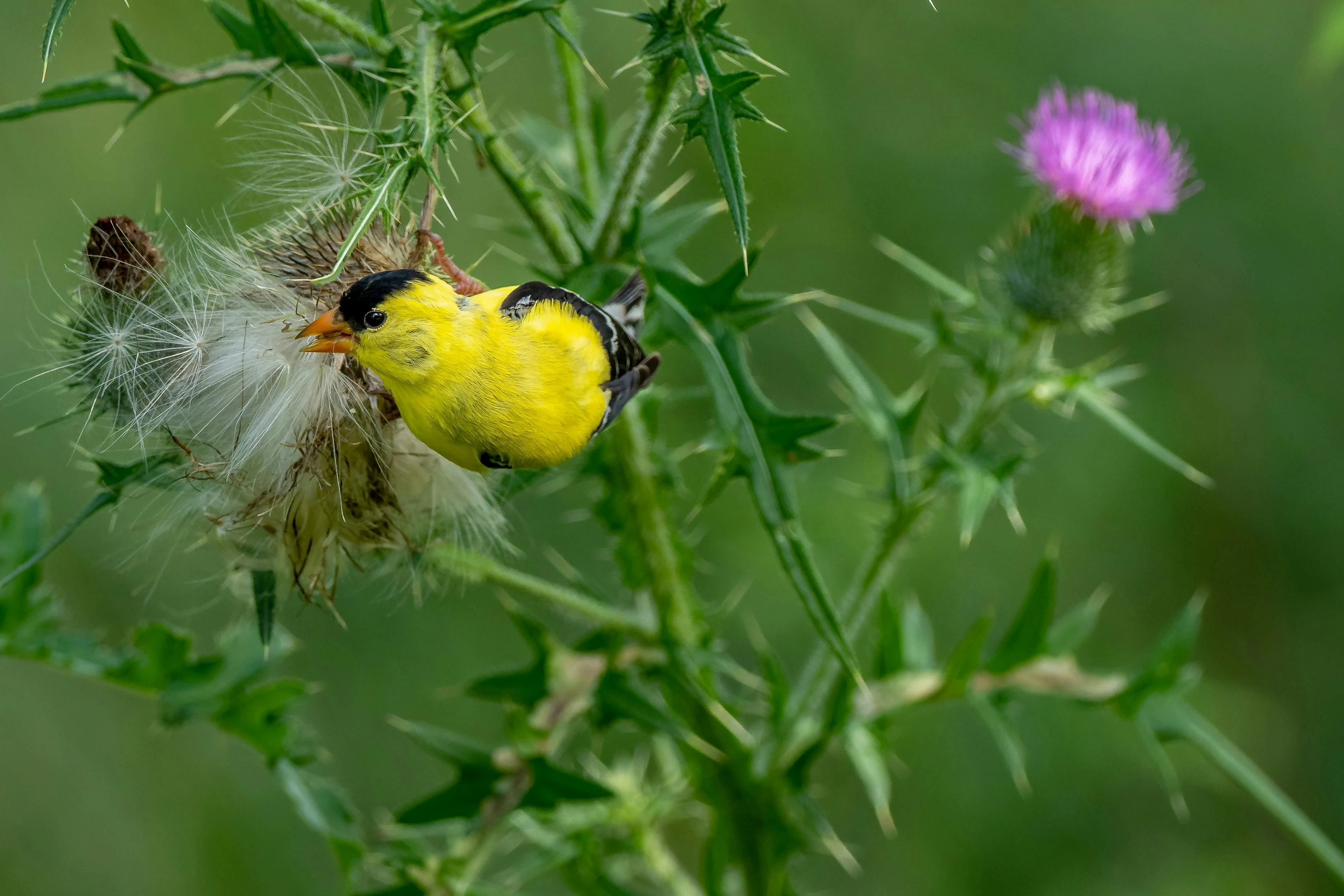
If a small bird at your feeder looks like it is wearing a canary costume with a black cap, American Goldfinch identification is easier than you might think, at least for half the year. This is one of the most common finches at Canadian feeders, but its look changes so much between seasons that many people assume they are seeing two different species. Here is how to tell breeding males, females, and dull winter birds apart, along with what they need to stick around your yard.
As an Amazon Associate, NorthernPerch.ca earns from qualifying purchases. Links to products may be affiliate links, at no extra cost to you.
Identification
Size: 11 to 13 cm long, one of the smallest finches you will see at a feeder, with a short conical bill built for cracking seeds.
Breeding male (spring and summer): Unmistakable. A bright lemon-yellow body, a neat black cap on the forehead, black wings with crisp white wing bars, a black tail edged in white, and an orange-pink bill.
Female (spring and summer): A duller olive-yellow overall, with no black cap. The wings are still black with white bars, just less contrasty than the male's.
Winter (both sexes): Both males and females moult into a dull olive-brown, closer to a sparrow's colouring than a goldfinch's. The black wings and white wing bars stay put through the moult, which is the easiest way to confirm you are still looking at a goldfinch and not something else entirely.
Flight and call: Goldfinches fly in a distinctive up-and-down bounce, closing their wings between beats. Listen for a cheerful, rhythmic call often written as per-chick-o-ree, frequently given in flight.
Could Be Confused With
The most common mix-up is the pine siskin, which shares feeders and habitat with goldfinches, especially in winter. Siskins are heavily streaked brown all over with only flashes of yellow in the wings and tail, while a winter goldfinch is a plain, unstreaked olive-brown. In summer, a yellow warbler can look superficially similar from a distance, but it lacks the black cap and wings entirely, has a thinner bill, and tends to stay in trees and shrubs rather than visiting feeders.
Habitat and Range
American Goldfinches are found across southern Canada from British Columbia to the Maritimes, in weedy fields, roadsides, overgrown meadows, open woodland edges, and backyards with feeders or seed-bearing plants. Many populations are only partial migrants. Birds in the mildest parts of the country stick around all year, while those farther north shift south for winter, which is part of why the same feeder can host far duller-looking goldfinches from December through March.
Behaviour
Goldfinches are one of the few songbirds that feed their young almost entirely on seeds rather than insects, which makes them unusually strict vegetarians for a bird. That diet also explains their odd nesting schedule: they are among the latest-nesting birds in Canada, often not starting until July, timed to coincide with the seed production of thistles and milkweed, which they use for both food and nest lining.
Outside of breeding season, goldfinches are highly social and gather in loose flocks, often moving between feeders and weedy fields together. That undulating flight and the constant chatter of calls are usually the first clue a flock is nearby before you spot the birds themselves.
How to Attract American Goldfinches
Nyjer, also sold as thistle seed, is the single best food for drawing goldfinches to a yard. It is a tiny, oil-rich seed that most larger birds ignore, which keeps a feeder from turning into a free-for-all for starlings and house sparrows. A wild finch seed blend that mixes Nyjer with canary seed, millet, and hemp, such as the Agri-Tel Wild Finch Feast (4 kg), is worth keeping on hand once you have a feeder up, and at around $43 CAD for 4 kg it covers a season of steady feeding. For a full breakdown of feeder styles, from budget sock feeders to squirrel-proof options, see our guide to the best finch feeders in Canada.
Native plants do a lot of the same work as a feeder, and for free. Coneflower, black-eyed Susan, and native thistle all produce seed heads goldfinches will strip well into fall, and leaving spent flower heads standing through autumn instead of deadheading them gives the birds a natural food source alongside your feeder.
Because goldfinches look so different in winter, they are also one of the species that shows up in odd numbers during finch irruption years alongside redpolls, siskins, and grosbeaks. If your feeder traffic looks unusual some winter, our annual winter finch forecast covers what is expected and why.
Frequently Asked Questions
When can I see American Goldfinches in Canada? Year-round across most of southern Canada, though the bright yellow breeding plumage is only present from roughly April through September. Outside that window, you are looking at the duller non-breeding plumage both sexes wear in winter.
Do American Goldfinches migrate? Many are only partial migrants. Birds in the mildest regions of southern Canada often stay put all year, while populations farther north tend to move south for winter, so feeder numbers can shift seasonally even where the species is considered a year-round resident.
Why did my goldfinch turn from yellow to a dull colour? That is the normal fall moult. Both male and female American Goldfinches replace their bright breeding feathers with dull olive-brown ones for winter, then moult back into colour the following spring. The black wings with white bars stay visible year-round and are the easiest way to confirm identification through the change.
What is the difference between a female and a non-breeding male American Goldfinch? Very little to the eye. Both are a similar dull olive-brown in winter. Some birders look for slightly blacker, higher-contrast wings on males, but in practice this is a difficult call in the field and not worth stressing over.
Final Thoughts
American Goldfinch identification comes down to remembering that this is a bird with two very different looks, not two different species, and that the black-and-white wings are your anchor point no matter the season. Keep a Nyjer feeder stocked and a few seed-bearing native plants in the yard, and goldfinches are one of the more reliable year-round visitors you can count on. For more ways to build out your yard for backyard birds generally, see our guide on how to attract more birds to your backyard.