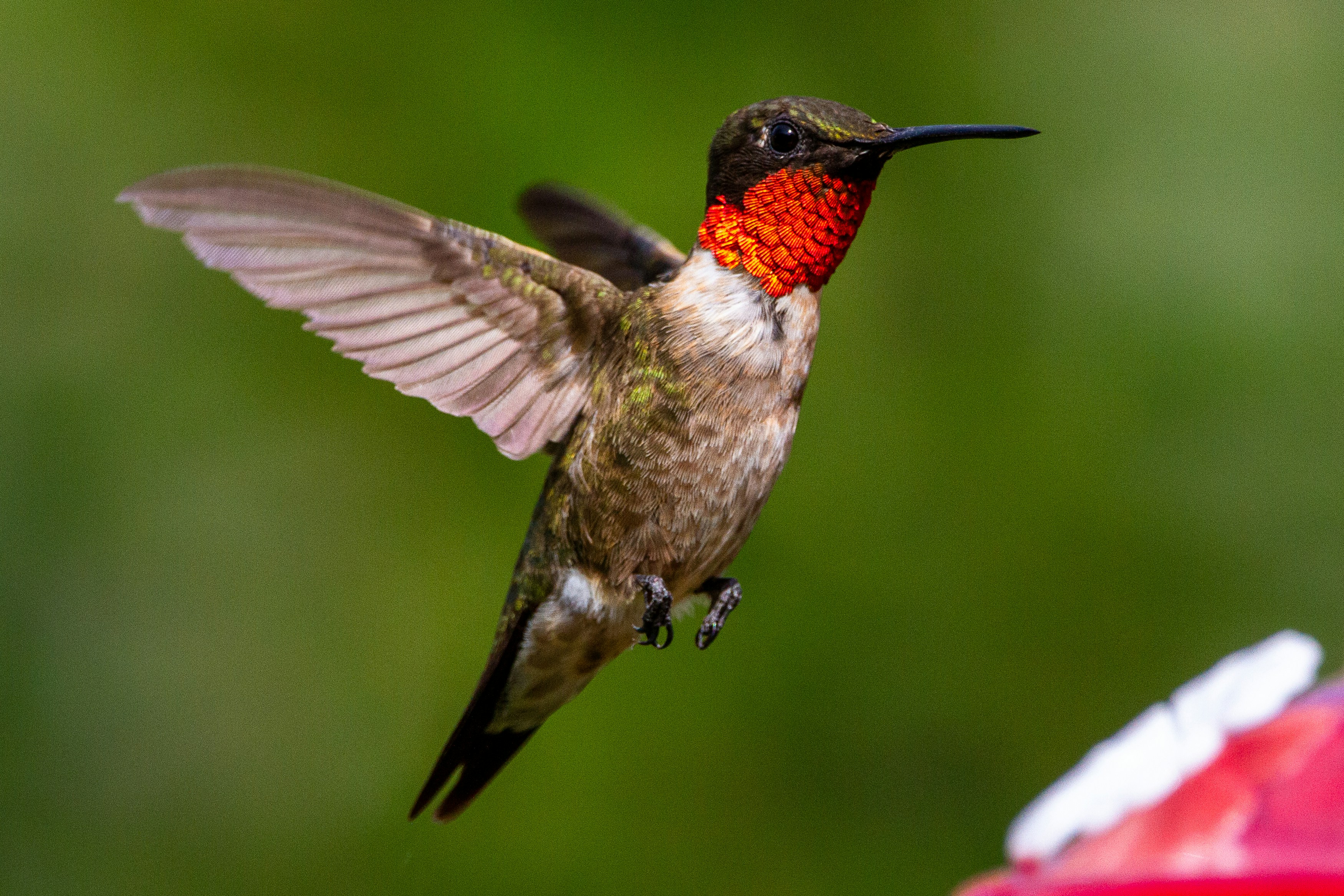
Ruby-Throated Hummingbird: ID, Range and Migration in Canada
If you have spotted a tiny green blur hovering at your flowers or feeder somewhere in eastern Canada, there is a very good chance you are looking at a ruby-throated hummingbird. It is the only hummingbird species that breeds regularly east of the Prairies, which makes identification refreshingly simple for most Canadian birders. This guide walks you through the field marks, the male and female differences, when to expect them province by province, and how to keep them coming back.
How to Identify a Ruby-Throated Hummingbird
The ruby-throated hummingbird is small even by hummingbird standards, measuring roughly 7 to 9 centimetres long and weighing about as much as a Canadian nickel. The back and crown are a bright, metallic emerald green, the underparts are pale greyish white, and the bill is long, thin, and straight.
The wings beat so fast they blur into a faint hum, and the birds can hover in place, fly backwards, and dart sideways with ease. When perched, they often hold their tail still and flick their wings, and they rarely sit for long.
The single most useful field mark is the throat, but that only helps with adult males. For everyone else, you are leaning on size, the green back, and behaviour. In most of eastern Canada the job is easier than it sounds, because there simply are not any other hummingbird species around to cause confusion.
Male vs Female: Telling Them Apart
Adult males have the feature the bird is named for: a brilliant, iridescent ruby-red throat patch called a gorget. The catch is that this patch only flashes red when light hits it at the right angle. In shade or from the wrong direction, the same throat can look black or dull, so do not rule out a male just because the red is not showing.
Females and immature birds lack the red gorget entirely. They have a plain whitish throat, sometimes with faint greyish streaking, and their tail feathers show white tips that the male lacks. Females are also slightly larger than males on average, though this is hard to judge in the field.
Young males in late summer can be confusing, often showing a few stray dark or reddish flecks on the throat as their adult plumage comes in. If you see a hummingbird with a messy, partial throat patch in August, an immature male is the likely answer.
How to Distinguish From Other Hummingbirds
Across most of Canada, the ruby-throated is the default and often the only option, so confident identification mostly comes down to ruling out lookalikes that appear in the west.
In British Columbia and parts of Alberta, ruby-throats are rare or absent, and you are far more likely to see rufous, Anna's, or calliope hummingbirds. The rufous hummingbird is the key one to know: males show extensive orange-brown colouring on the back and sides, which a ruby-throat never has. A green-backed bird in eastern Canada is almost certainly a ruby-throat, while a rusty-orange bird out west is not.
Females and immatures of different species are genuinely tricky and challenge even experienced birders. If you are in the eastern half of the country, lean on range: a hummingbird in Ontario, Quebec, or the Maritimes in summer is overwhelmingly likely to be a ruby-throated. A good field guide or a bird ID app helps for the rare western strays.
Canadian Range and Migration Timing
Ruby-throated hummingbirds breed across the eastern and central parts of the country, from the Prairies through Ontario, Quebec, and into Atlantic Canada. They spend the winter far to the south, mostly in Mexico and Central America, and a remarkable number cross the Gulf of Mexico in a single non-stop flight.
Spring arrival sweeps north and west as the weather warms. As a rough guide for a typical year:
- Southern Ontario and southern Quebec: late April into early May
- Maritimes (Nova Scotia, New Brunswick, PEI): early to mid May
- Manitoba and Saskatchewan: mid to late May
- Northern Ontario, northern Quebec, and Alberta edges of the range: late May into early June
These dates shift year to year with the weather, so it pays to have your feeder up a week or two before you expect the first birds. The males usually arrive first to establish territory, with females following shortly after. By late August and into September, most birds begin heading south again, and the majority have left Canada by the time the first hard frosts arrive.
A common worry is that leaving a feeder up in fall will stop birds from migrating. It will not. Migration is triggered by day length, not food supply, so a late feeder simply helps stragglers fuel up for the journey.
Habitat and Feeding Behaviour
Ruby-throated hummingbirds favour the edges of deciduous and mixed woodlands, gardens, orchards, and parks, anywhere with a mix of flowers and perching cover. In Canada that includes plenty of suburban backyards, which is why so many people get to enjoy them up close.
Their diet is built around two things: nectar and small insects. The nectar provides quick energy for that frantic metabolism, while tiny insects and spiders supply the protein they need, especially when raising young. They will also drink tree sap from the small holes drilled by sapsuckers in early spring before many flowers have opened.
They are fiercely territorial for their size. A single bird will often guard a feeder or flower patch and chase off rivals with surprising aggression, including birds many times larger.
What Flowers They Prefer
Ruby-throats are strongly drawn to tubular flowers, especially red and orange ones, though they will visit many colours. Their long bill and tongue are built to reach nectar deep inside these blooms.
Good Canadian garden choices include bee balm, cardinal flower, columbine, trumpet honeysuckle, salvia, and jewelweed. Native plants are ideal because they bloom in sync with the birds' natural cycle. Planting a mix that flowers from late spring through late summer gives the birds a steady food source for their whole stay.
Attracting Ruby-Throated Hummingbirds to Your Backyard
Flowers do a lot of the work, but a sugar-water feeder is the fastest way to bring hummingbirds into view. A good feeder is easy to clean, has some red on it, and includes bee guards or an ant moat to keep pests out. A simple, reliable choice is the Perky-Pet glass hummingbird feeder, which comes apart easily for the frequent cleaning these feeders need.
The nectar itself could not be simpler. Mix one part plain white sugar to four parts water, stir until dissolved, and skip any red dye, which is unnecessary and best avoided. If you would rather not measure, a pre-made concentrate like Perky-Pet hummingbird nectar concentrate takes the guesswork out, though plain sugar water works just as well and costs less.
The single most important habit is cleaning. In Canadian summer heat, change the nectar every two to three days, and more often during hot spells, since sugar water spoils quickly and can harm the birds. For a deeper comparison of feeder styles and what to look for, see our guide to the best hummingbird feeders in Canada.
Frequently Asked Questions
When do ruby-throated hummingbirds arrive in Ontario?
In southern Ontario, the first ruby-throated hummingbirds typically arrive in late April to early May, with males usually showing up a few days ahead of females. Further north in the province, expect them later, often into the second half of May. Putting your feeder out by mid to late April gives you the best chance of catching the early arrivals.
How do I attract ruby-throated hummingbirds?
Combine nectar-rich tubular flowers with a clean sugar-water feeder. Plant red and orange blooms such as bee balm, cardinal flower, and trumpet honeysuckle, hang a feeder with a bit of red on it, and fill it with a one-to-four sugar-to-water mix. Keep the feeder clean and the nectar fresh, and place it where you can watch it from a window.
What do ruby-throated hummingbirds eat?
They eat flower nectar for energy and small insects and spiders for protein. In early spring they also drink tree sap from holes drilled by sapsuckers. At feeders, they drink a simple solution of white sugar dissolved in water, which mimics natural flower nectar.
Do I need to take my hummingbird feeder down in the fall?
No. Leaving a feeder up will not prevent hummingbirds from migrating, because migration is driven by day length rather than food. A feeder left up into early fall actually helps late stragglers refuel. Once a couple of weeks pass with no visitors after the first frosts, it is safe to clean and store it.
What is the difference between a male and female ruby-throated hummingbird?
The adult male has a brilliant iridescent red throat patch, while the female has a plain whitish throat and white-tipped tail feathers. The male's red gorget can look black in poor light, so check the throat from several angles. Immature males in late summer may show a few scattered dark or red throat flecks.
Final Thoughts
The ruby-throated hummingbird is one of the easiest and most rewarding backyard birds to attract across eastern and central Canada, asking for little more than a clean feeder and a few well-chosen flowers. Get the timing right in spring and you will have a front-row seat to one of the country's tiniest and most charismatic summer visitors. For more ways to make your yard a magnet for birds, see our guide on How to Attract More Birds to Your Backyard in Ontario.